How Does Digital Marketing Works?
Imagine someone needs a product or service today.
What do they usually do?
They may search on Google, check Instagram, watch a YouTube video, read reviews, compare businesses, visit a website, and then decide whether to contact or buy from a particular brand.
This entire journey helps explain how does digital marketing works.
Digital marketing is not simply about running advertisements or posting content on social media. It is a complete process of attracting the right audience, giving them useful information, building trust, and guiding them toward taking action.
For a business, the process can look like this:
Audience → Awareness → Interest → Trust → Website Visit → Conversion → Customer
In this guide, we will explain 15 strategies that show how digital marketing works and how businesses can use them to attract more customers.
What Is Digital Marketing?
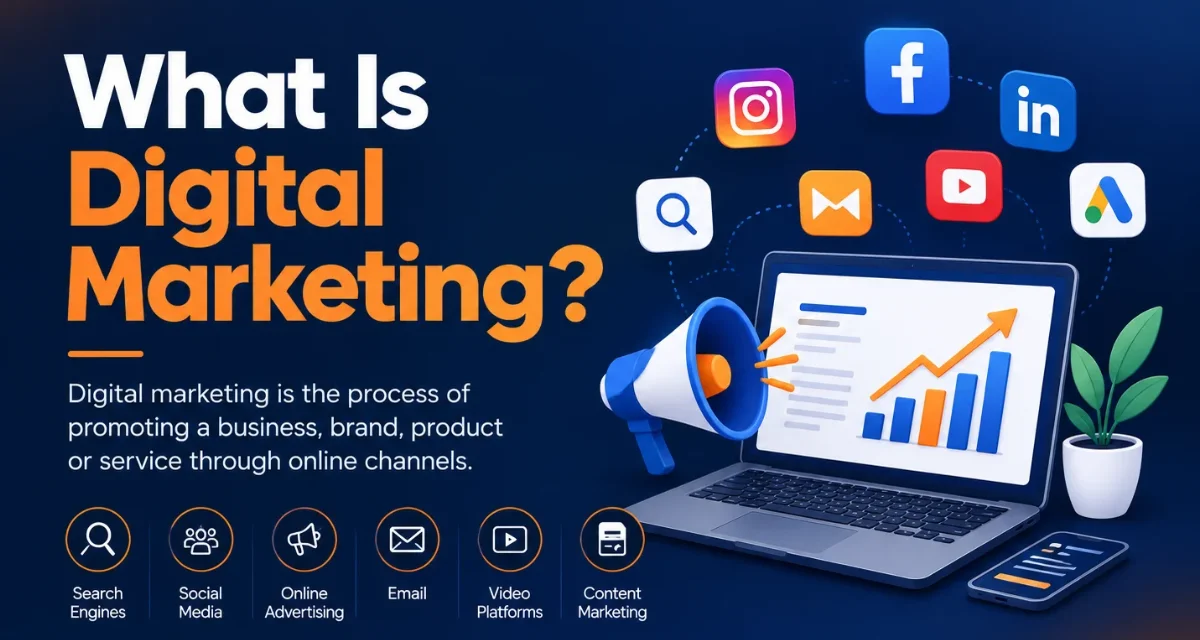
Digital marketing is the promotion of a business, brand, product, or service through digital channels.
These channels can include:
- Search engines
- Websites
- Social media
- Online advertising
- Video platforms
- Content marketing
- Mobile platforms
Unlike a single advertisement, digital marketing can connect multiple touchpoints throughout the customer’s journey.
For example:
Google Search → Blog → Website → Instagram → Retargeting Ad → Enquiry
Each interaction can contribute to the customer’s decision-making process.
That is why understanding how does digital marketing works requires looking at the complete customer journey rather than focusing on only one channel.
15 Strategies to Attract More Customers Through Digital Marketing
1. Identify Your Ideal Customer
The first step is understanding who you want to attract.
Before creating content or advertisements, ask:
- Who is your ideal customer?
- What problem are they trying to solve?
- What are they searching for online?
- Which platforms do they use?
- What factors influence their buying decision?
- What objections might stop them from purchasing?
For example, a luxury furniture brand and a local fast-food restaurant will not necessarily have the same audience, messaging, or digital strategy.
The more clearly you understand your customer, the easier it becomes to create relevant marketing.
2. Build a Strong Digital Presence

Customers need to be able to find your business online.
Your digital presence may include:
- Website
- Google Business Profile
- Social media profiles
- Blog
- Online reviews
- Video content
- Business listings
Your website acts as an important destination where potential customers can learn more about your business.
A strong digital presence should make three things clear:
Who are you?
What do you offer?
Why should customers trust you?
For businesses looking to understand how these elements can work together, you can explore the CORE N CLICK website. The website describes its approach around SEO, paid media, content, social media, and conversion-focused websites.
3. Create Content That Answers Customer Questions
People don’t always search for a company immediately.
Often, they search for an answer.
For example:
“How much does an office chair cost?”
“How can I improve my website?”
“Which digital marketing strategy is best for a small business?”
“How can I increase Instagram engagement?”
If your business creates useful content around these questions, you can introduce your brand before the person is ready to buy.
Content can include:
- Blog posts
- Videos
- Reels
- Guides
- Tutorials
- Case studies
- Infographics
- FAQs
The objective is simple:
Help first. Sell later.
4. Use SEO to Reach People Searching on Google
Search engines can be an important source of potential customers.
SEO helps businesses improve the visibility of their website and content in organic search results.
Imagine someone searches:
“How to choose a digital marketing agency?”
A useful article answering that question can introduce your business to that person.
A strong SEO strategy can involve:
- Keyword research
- Search intent
- Helpful content
- On-page optimization
- Technical SEO
- Internal linking
- Structured data
- Authority building
SEO is particularly valuable because it focuses on connecting content with people who are actively searching for information.
5. Understand Search Intent
Not every search means the same thing.
Consider these three searches:
Informational
“What is digital marketing?”
The user wants to learn.
Commercial
“Best digital marketing agency for small business”
The user may be comparing options.
Transactional
“Hire digital marketing agency in Surat”
The user may be ready to take action.
Understanding search intent helps you create the right content for the right stage of the customer journey.
This is one of the most important concepts behind how does digital marketing works because the same customer may have different search intentions at different stages.
6. Understand How Internet Advertising Works
Online advertising can put a business in front of a specific audience.
But how internet advertising works depends on the platform, campaign objective, targeting options, bidding model, creative, and audience.
Common forms of online advertising include:
- Search ads
- Display ads
- Social media ads
- Video ads
- Sponsored content
- Retargeting
For example, search advertising can appear when someone searches for a relevant keyword, while social media advertising can use audience characteristics and platform signals to deliver ads.
The basic process looks like:
Choose Objective → Select Audience → Create Ad → Set Budget → Launch → Measure → Optimize
Understanding how internet advertising works is important because simply putting money behind an advertisement does not guarantee meaningful business results.
The advertisement needs to reach an appropriate audience with a relevant message.
7. Use Social Media to Build Awareness and Trust
Social media has become an important part of how people discover and evaluate brands.
Businesses can use platforms such as:
- YouTube
- X
depending on where their target audience spends time.
Social media can help businesses:
- Educate audiences
- Share useful content
- Demonstrate expertise
- Answer questions
- Build communities
- Showcase customer experiences
- Generate website traffic
The goal shouldn’t always be “get more followers.”
A better question is:
Are we attracting the right people and giving them a reason to stay connected?
8. Understand How Social Media Marketing Agency Works
Many business owners wonder how social media marketing agency works behind the scenes.
A professional social media process usually starts with understanding the business and its audience.
A simplified workflow can look like:
Research → Strategy → Content Planning → Creative → Publishing → Engagement → Analytics → Optimization
For example, a business may first identify its target audience and content themes.
Then it can create:
- Educational posts
- Short videos
- Carousels
- Customer stories
- Industry insights
- Behind-the-scenes content
After publishing, performance data can be reviewed to understand what type of content receives meaningful engagement.
This helps explain how social media marketing agency works beyond simply creating and uploading posts.
For more information about CORE N CLICK’s background and approach, visit the CORE N CLICK About page. The page describes its senior-led, revenue-focused and full-funnel approach.
9. Use Paid Media to Accelerate Reach
Organic visibility can take time.
Paid media provides another way to distribute content and offers to selected audiences.
So, how paid media works can be understood through a simple process:
Budget → Audience → Ad → Placement → Click/Interaction → Landing Page → Action
Paid media can include:
- Google Ads
- Meta Ads
- Display advertising
- Video advertising
- Sponsored content
- Retargeting
Paid media can be used for different objectives, including awareness, traffic, leads, sales, or other measurable actions.
Current industry guidance also describes paid media as advertising where a brand pays for placements to reach selected audiences, with formats including PPC, sponsored social posts, display, video, and sponsored content.
10. Create a Website That Converts Visitors
Getting traffic is not enough.
Imagine 1,000 people visit your website, but nobody understands what to do next.
You have traffic—but very little business value.
Your website should make it easy for visitors to:
- Understand your offer
- Find important information
- Trust your business
- Navigate between pages
- Contact you
- Request information
- Make a purchase
Important elements include:
Clear headline
Tell visitors immediately what the page is about.
Simple navigation
Don’t make visitors search for basic information.
Strong trust signals
Use reviews, testimonials, case studies, credentials, or other relevant evidence.
Clear CTA
Give visitors an obvious next step.
The website is often where awareness turns into action.
11. Use Retargeting to Bring Interested Visitors Back
Not every visitor is ready to buy during their first visit.
Someone might:
- Discover your brand.
- Visit your website.
- Read a blog.
- Leave.
- Think about the purchase.
- Return later.
Retargeting can help businesses reconnect with eligible audiences who have previously interacted with their website or content, subject to platform rules and user consent.
This can be useful because the audience already knows something about the brand.
Retargeting is one example of how paid media works as part of a broader customer journey rather than as a standalone advertisement.
12. Use Email to Nurture Potential Customers
Some customers need more information before making a decision.
Email marketing can help businesses maintain communication with people who have voluntarily subscribed.
For example, a business could send:
- Educational articles
- Guides
- Industry insights
- Product information
- Newsletters
- Case studies
- Special announcements
Instead of asking for a sale in every message, businesses can use email to provide ongoing value.
This can help move people from:
Interested → Informed → Confident → Ready to Act
13. Build Trust With Social Proof
Before buying from an unfamiliar business, people often look for evidence.
They may check:
- Reviews
- Testimonials
- Ratings
- Case studies
- Customer stories
- Portfolio examples
- User-generated content
Social proof can reduce uncertainty because potential customers can see experiences or evidence from other people.
For example, a customer considering a service may look for reviews before contacting the company.
Trust is therefore an important part of the digital customer journey.
14. Measure the Right Digital Marketing Metrics
One major advantage of digital marketing is that many activities can be measured.
Depending on your goal, useful metrics can include:
| Objective | Possible Metrics |
| Awareness | Reach, impressions, brand searches |
| Engagement | Engagement rate, comments, shares, watch time |
| Traffic | Sessions, users, clicks |
| Leads | Leads, cost per lead, lead quality |
| Sales | Revenue, conversions, customer acquisition cost |
| Advertising | CPC, CTR, CPM, ROAS |
| Website | Conversion rate, bounce/engagement metrics |
The important thing is not to track every number simply because it is available.
Track the metrics connected to your business objective.
For example:
More likes ≠ automatically more sales.
A business should understand how its marketing activities contribute to meaningful business outcomes.
15. Test, Learn, and Improve
Digital marketing is not a “set it and forget it” process.
Markets change.
Customer behavior changes.
Platforms change.
Competition changes.
That’s why testing is important.
You can test:
- Headlines
- Images
- Videos
- CTAs
- Landing pages
- Audiences
- Content formats
- Ad messages
- Offers
The process can look like:
Launch → Measure → Learn → Improve → Test Again
This continuous feedback loop is a major part of how does digital marketing works.
How Does Digital Marketing Works From First Click to Customer?
Let’s simplify everything into one example.
Imagine a person needs digital marketing information.
Step 1 — Discovery
They search Google.
Step 2 — Content
They find your educational blog.
Step 3 — Engagement
They explore your website and social media.
Step 4 — Trust
They read your content, reviews, and business information.
Step 5 — Consideration
They compare your business with other options.
Step 6 — Conversion
They contact you or complete another desired action.
Step 7 — Retention
You continue providing value and maintaining the relationship.
This is the simplest way to understand how does digital marketing works as a complete system.
How Internet Advertising Works With Organic Marketing
Another important concept is that paid and organic marketing don’t have to operate separately.
For example:
SEO → attracts organic search traffic
Content → educates visitors
Social media → builds awareness and engagement
Paid advertising → distributes messages to selected audiences
Website → provides information and conversion opportunities
Email → nurtures interested people
Analytics → shows what is happening
This creates a connected ecosystem rather than isolated marketing activities.
That’s why understanding how internet advertising works should be part of a broader marketing strategy.
How Paid Media Works With the Customer Journey
Paid media can support different stages of the funnel.
Awareness
A business can use display, video, or social advertisements to introduce itself to relevant audiences.
Consideration
Businesses can promote educational content, guides, or relevant landing pages.
Conversion
Search or social campaigns can direct users toward an action-focused landing page.
Retention
Eligible existing audiences can receive relevant campaigns based on platform capabilities and applicable privacy requirements.
This explains why how paid media works is not simply about getting clicks. The campaign needs to fit the customer’s stage and the business objective.
Common Digital Marketing Mistakes Businesses Should Avoid
1. Targeting Everyone
A message designed for everyone may not strongly connect with anyone.
2. Creating Content Without Understanding the Audience
Content should answer real questions and problems.
3. Focusing Only on Vanity Metrics
Followers and likes can be useful signals, but they aren’t the only indicators of business performance.
4. Ignoring the Website
A great advertisement cannot fix every problem with a poor website experience.
5. Running Ads Without Tracking
If you don’t measure results, you don’t know what needs improvement.
6. Expecting Every Channel to Produce Immediate Results
SEO, content, social media, email, and paid advertising can have different timelines and roles.
FAQs
1. How does digital marketing works for a small business?
How does digital marketing works for a small business depends on its audience, industry, goals, budget, and available resources. A business can combine content, SEO, social media, online advertising, email, and a conversion-focused website to reach and nurture potential customers.
2. How internet advertising works for a business?
How internet advertising works depends on the platform and campaign. Generally, businesses define an objective, choose an audience, create advertisements, set a budget, distribute the ads, and analyze performance.
3. How social media marketing agency works?
How social media marketing agency works typically involves research, strategy, content planning, creative production, publishing, community management, reporting, and optimization.
4. How paid media works?
How paid media works involves paying for advertising placements to reach selected audiences. The campaign can be measured using metrics such as impressions, clicks, conversions, cost per result, and return on advertising spend.
5. Is digital marketing only about advertising?
No. Advertising is only one part of digital marketing. SEO, content, websites, social media, email, analytics, and customer relationships can all play a role.
6. How long does digital marketing take to produce results?
There is no single timeline. Results depend on the channel, competition, budget, audience, website, offer, content quality, and execution. Paid campaigns can begin generating measurable data quickly, while organic strategies such as SEO generally require more time to build visibility.
Final Thoughts
So, how does digital marketing works?
At its core, it works by connecting the right message with the right audience at the right stage of their customer journey.
It starts with understanding your audience.
Then you build visibility through search, content, social media, and other channels. You create useful experiences, build trust, bring relevant visitors to your website, and give them a clear path to take action.
The process doesn’t stop after the first conversion.
Businesses can continue measuring results, learning from customer behavior, improving their campaigns, and building long-term relationships.
The most important lesson is simple:
Digital marketing isn’t about being everywhere. It’s about being useful where your customers are looking.
If you want to understand how CORE N CLICK approaches digital marketing, you can visit the CORE N CLICK website or learn more about the company through its About page.